
Businorem ipsum dolor sit amet cons interdum quam duis variuy time honored tradition etting .
Businorem ipsum dolor sit amet cons interdum quam duis variuy time honored tradition etting .
 July 28, 2026
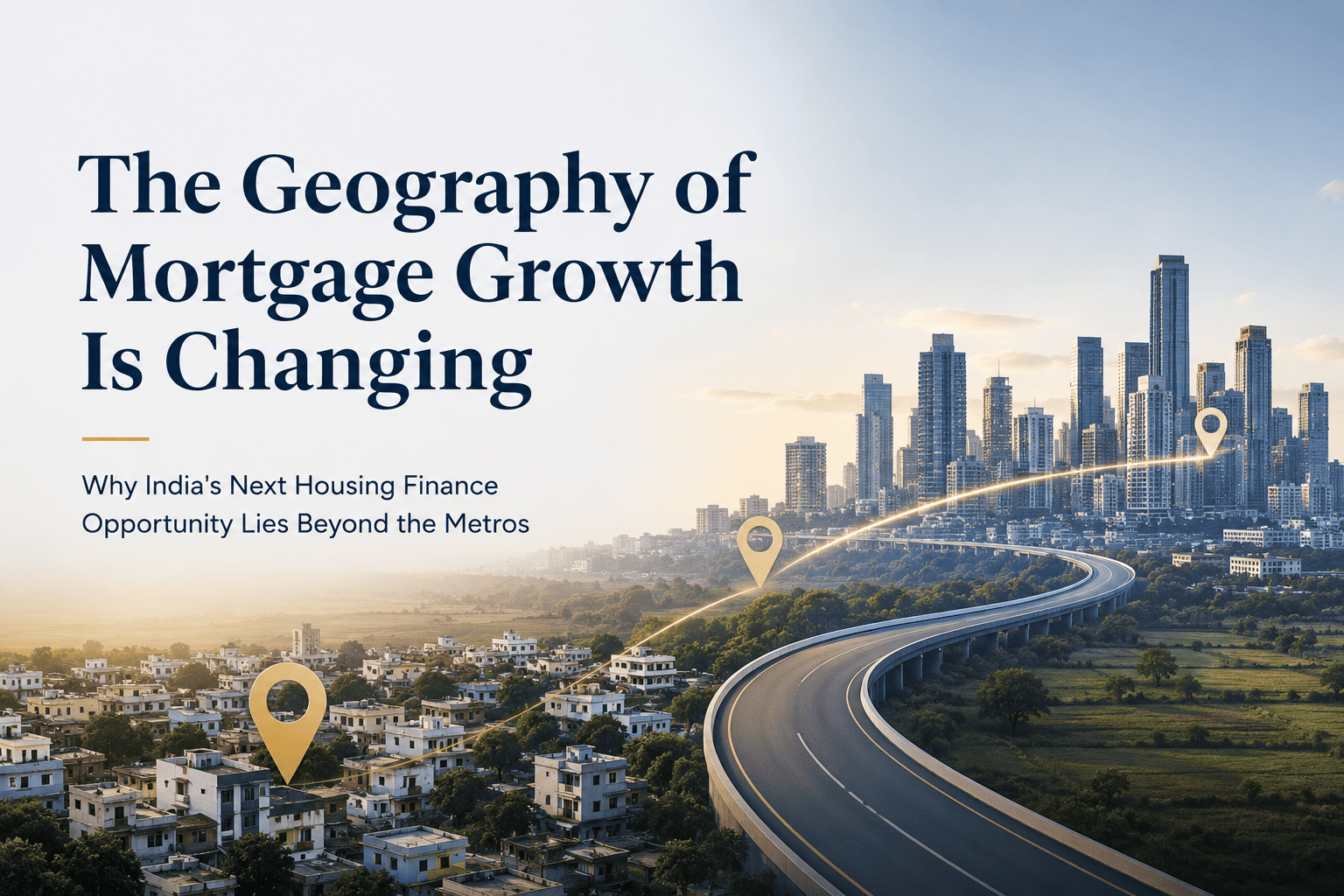
 Why India’s Next Housing Finance Opportunity Lies Beyond the Metros
For much of the last three decades, India’s mortgage market followed a predictable rule: capital flowed where economic activity was concentrated. As Mumbai, Delhi NCR, Bengaluru, Chennai and Hyderabad emerged as the country’s economic engines, they also became the primary engines of mortgage growth. Lenders refined branch networks, underwriting models and distribution strategies around these markets and for good reason.
That playbook is becoming less reliable.
The next decade of mortgage growth is unlikely to be driven by the continued expansion of India’s largest metropolitan regions alone. Instead, it will be shaped by a quieter but more consequential shift: the redistribution of economic activity across the country. Jobs, investment and infrastructure are no longer concentrating in a handful of cities; they are spreading across new industrial corridors, logistics hubs, manufacturing clusters and emerging service centres. Mortgage demand will follow that geography.
This is more than an urbanisation story. It is an economic realignment.
Consider what has changed over the past few years. Manufacturing investments under production-linked incentive (PLI) schemes, the rapid expansion of Global Capability Centres (GCCs), industrial corridors, expressways, multimodal logistics networks and state-led infrastructure programmes are creating new employment centres outside India’s traditional metros. Cities such as Indore, Coimbatore, Surat, Nagpur, Lucknow and Bhubaneswar are no longer viewed merely as regional markets – they are becoming destinations for investment, skilled employment and business expansion.
History suggests that housing demand rarely leads economic transformation; it follows it. Employment creates household formation, household formation creates demand for home ownership, and sustained home ownership creates demand for long-term housing finance. The mortgage opportunity therefore lies not simply where population is growing, but where formal economic activity is taking root.
This distinction matters.
Many lenders continue to evaluate geographic expansion using historical disbursement volumes, existing branch performance or market share. These indicators explain where business has been not where it is likely to emerge. As India’s economic landscape evolves, yesterday’s lending map may become an increasingly poor guide for tomorrow’s growth.
A more forward-looking approach begins by asking different questions. Which cities are attracting long-term industrial investment rather than cyclical real estate activity? Where are formal jobs growing faster than housing supply? Which infrastructure projects are likely to reshape commuting patterns, land values and residential development over the next decade? These questions identify future mortgage markets long before loan books begin to reflect them.
This also challenges the tendency to view Tier II and Tier III cities as a single opportunity. They are not.
Each emerging market is being shaped by a different growth engine. Some cities are becoming manufacturing hubs, others are strengthening their position as technology or GCC destinations, while others are benefiting from logistics infrastructure, defence investments or educational ecosystems. These differences influence household incomes, borrower profiles, property markets and credit behaviour. A one-size-fits-all expansion strategy risks overlooking these structural distinctions.
For HFCs and NBFCs, this has implications far beyond branch expansion.
Distribution models, underwriting practices and product design will need to evolve alongside changing market dynamics. Borrowers in emerging cities often have different income patterns, occupational profiles and documentation standards than those in mature metropolitan markets. Success will depend on combining local market intelligence with digital capabilities, rather than relying exclusively on traditional credit assessment or physical presence.
More importantly, competitive advantage may increasingly come from identifying economic shifts before competitors do. The next market leader may not be the institution with the largest branch network, but the one with the strongest understanding of where India’s next employment clusters, infrastructure investments and housing demand are likely to emerge.
For leadership teams, this raises a broader strategic question. Should geographic expansion continue to be planned around administrative boundaries such as Tier I, Tier II and Tier III cities or should it instead be organised around economic corridors, investment clusters and future employment centres? The distinction is subtle, but it has profound implications for capital allocation, distribution strategy and long-term portfolio quality.
India’s mortgage market is not simply expanding; it is relocating.
The institutions that recognise this shift early will move beyond conventional market classifications and begin treating economic geography as a strategic capability. In the years ahead, competitive advantage will depend less on serving the largest cities better and more on identifying tomorrow’s mortgage markets before they become obvious to everyone else.
The map of opportunity is being redrawn. The question for lenders is whether their strategy is evolving with it.