
Businorem ipsum dolor sit amet cons interdum quam duis variuy time honored tradition etting .
Businorem ipsum dolor sit amet cons interdum quam duis variuy time honored tradition etting .
 September 15, 2026
 In an increasingly digital lending environment, significant attention is being placed on technology, analytics and automated credit decisioning. Yet, for lenders operating through branch- and field-intensive models, one of the most critical elements of the lending value chain remains on the ground: the Field Officer (FOS).
The FOS is often the first meaningful point of interaction between the lender and the customer. Their role extends beyond sourcing applications. They engage with customers, understand their circumstances, support documentation, conduct field-level verification and provide critical inputs into the credit assessment process. In segments such as affordable housing, MSME and self-employed lending, where customer information may be less structured, the quality of this interaction can have a direct bearing on both business growth and portfolio quality.
Despite this, FOS performance is often assessed primarily through productivity metrics – applications sourced, sanctions achieved or disbursements generated. While these measures are important, they can provide an incomplete picture of frontline effectiveness.
A high-performing FOS should not simply be one who generates more business. The more relevant question is whether the business generated is sustainable, profitable and aligned with the lender’s risk appetite.
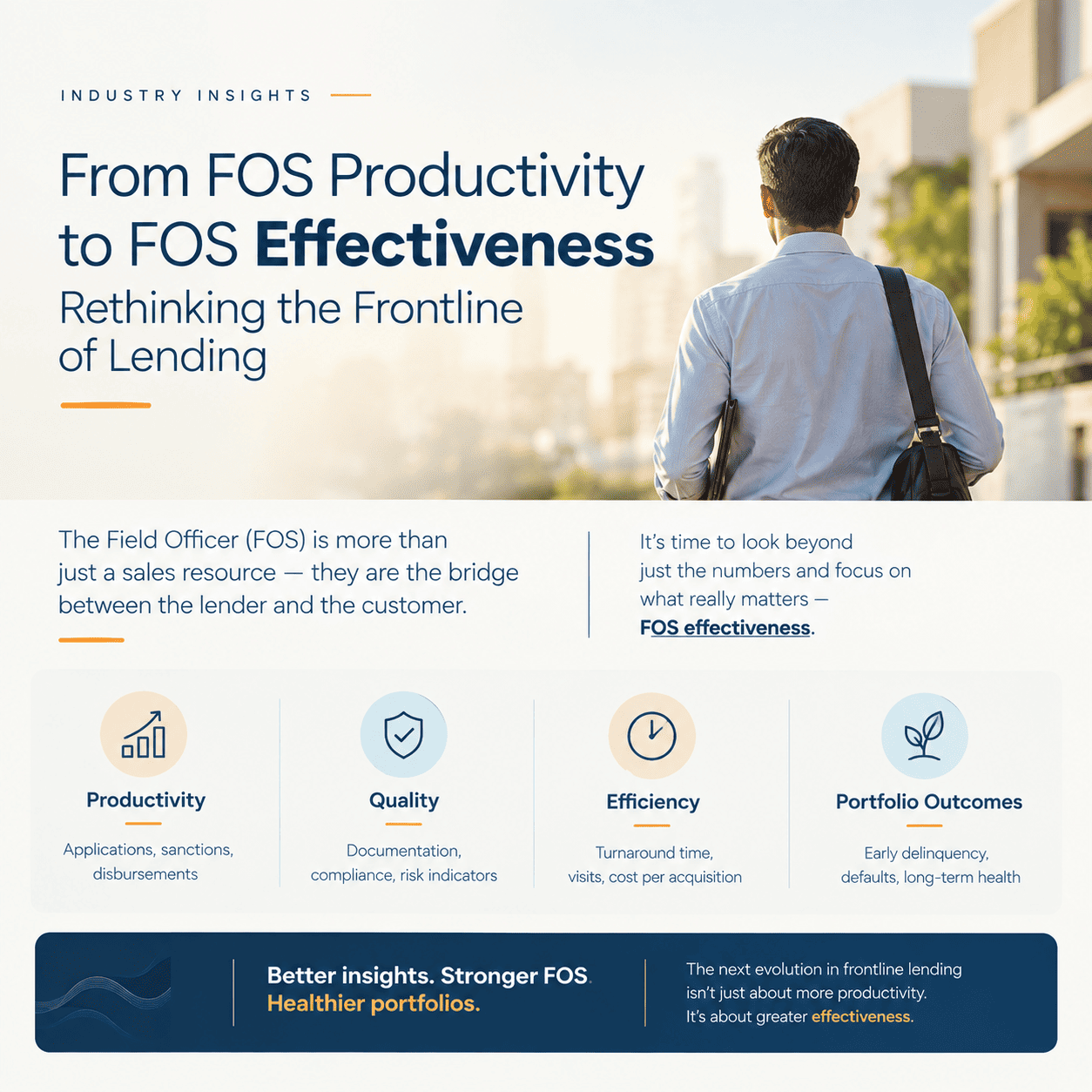
This requires a shift from measuring FOS productivity to FOS effectiveness.
A comprehensive FOS effectiveness framework should consider four dimensions. The first is Productivity – the volume of applications, sanctions and disbursements generated relative to the FOS’s capacity. The second is Quality – including documentation accuracy, sourcing quality, policy adherence, deviations and early delinquency indicators. The third is Efficiency – measured through turnaround time, field visits, cases handled and cost per acquisition. Finally, and most importantly, are Portfolio Outcomes, including early-stage delinquency, first-payment defaults and longer-term portfolio performance.
This distinction is critical because an incentive structure focused predominantly on volumes can unintentionally encourage behaviours that create downstream costs. A FOS may achieve strong disbursement numbers while sourcing customers with weaker credit profiles, incomplete documentation or higher fraud risk. The immediate business metric may look positive, while the eventual impact emerges through higher credit costs, collections effort and operational leakage.
The objective, therefore, should be to create a balanced performance management system where growth and quality are evaluated together.
Technology can play an important role in enabling this transition. Data-driven dashboards can provide FOS-level visibility into conversion rates, portfolio quality, turnaround times and customer-level risk indicators. This can allow managers to identify not only the highest-volume FOSs, but also those consistently generating high-quality business. Training and incentives can then be differentiated based on these insights.
Ultimately, the FOS should not be viewed merely as a sales or operating resource. For lenders with a significant physical distribution model, the FOS represents a critical control point between the institution and the customer – one that can influence growth, risk, customer experience and cost simultaneously.
The next evolution in frontline lending is therefore not simply about increasing FOS productivity. It is about improving FOS effectiveness: ensuring that every incremental customer sourced contributes not only to AUM growth, but to sustainable and risk-adjusted value creation.