
Businorem ipsum dolor sit amet cons interdum quam duis variuy time honored tradition etting .
Businorem ipsum dolor sit amet cons interdum quam duis variuy time honored tradition etting .
 July 7, 2026
 Over the past few years, co-lending has evolved from a regulatory construct into a strategic growth lever for India’s lending ecosystem. The model offers a compelling proposition: banks contribute capital and balance-sheet strength, while NBFCs and fintechs provide customer access, underwriting capabilities, and distribution reach. In theory, the arrangement allows both parties to leverage their respective strengths while improving credit penetration across underserved borrower segments.
The momentum behind co-lending is understandable. Faced with increasing competitive intensity, rising customer acquisition costs, and the need to expand into new markets, lending institutions are actively seeking partnership-led growth models. Co-lending appears to offer an attractive solution.
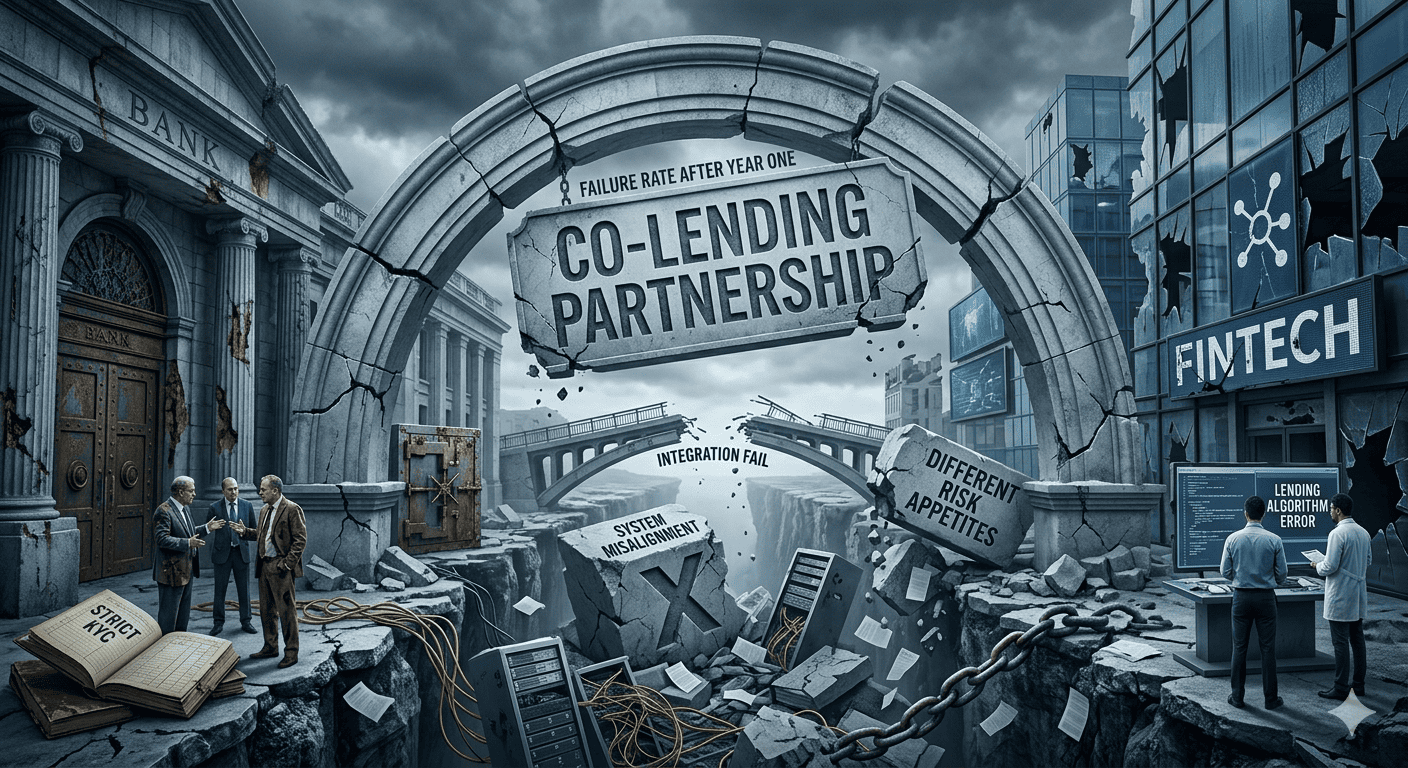
Yet, despite strong initial interest, many partnerships struggle to sustain performance beyond the first 12 to 18 months. While disbursement volumes often accelerate during the launch phase, momentum frequently slows as institutions encounter operational complexity, diverging priorities, and governance challenges that were not fully anticipated during partnership design.
The reality is that successful co-lending requires far more than capital participation and loan sourcing. It demands alignment across operating models, risk management philosophies, customer strategies, and decision-making frameworks. In the absence of such alignment, partnerships often begin to lose effectiveness as they scale.
Strategic alignment does not guarantee operating alignment
Most co-lending partnerships are established on a strong strategic foundation. Both institutions can clearly articulate the value proposition, target customer segments, and expected commercial benefits.
However, strategic alignment alone rarely ensures operational success.
As portfolios grow, institutions are required to work together across underwriting, documentation, disbursement, servicing, collections, compliance, reporting, and customer grievance management. Even relatively small differences in processes, turnaround expectations, approval hierarchies, or accountability structures can create significant friction.
Challenges that appear manageable during pilot phases often become disproportionately complex at scale. Manual workarounds become unsustainable, operational exceptions increase, and decision-making slows.
Many partnerships fail not because the strategic rationale was flawed, but because the operating model was never designed to support long-term execution.
Alignment on risk appetite often proves more difficult than expected
One of the most common misconceptions in co-lending is that shared credit exposure automatically translates into shared risk philosophy.
In practice, institutions often have fundamentally different approaches to risk assessment. NBFCs and fintechs may possess deep expertise in niche customer segments and may therefore be comfortable operating within risk parameters that banks find difficult to accept. Conversely, banks may impose controls and policy restrictions that lending partners perceive as excessively conservative.
These differences frequently remain hidden during the early stages of a partnership when portfolio performance is relatively stable. They become more visible as portfolios mature and delinquency trends begin to emerge.
Questions around underwriting standards, policy exceptions, collection strategies, restructuring decisions, and acceptable loss thresholds can quickly become points of contention.
Sustainable co-lending arrangements require alignment not only on credit exposure, but also on how risk is identified, measured, managed, and absorbed over time.
Technology integration is rarely the primary challenge
Technology integration is often cited as one of the biggest barriers to successful co-lending. While system integration is undoubtedly important, the more significant challenge is typically process integration.
Most institutions today possess the capability to establish data exchange mechanisms and interface connectivity. The greater difficulty lies in integrating workflows, controls, governance requirements, and reporting standards across two distinct organizations.
Differences in operational practices can create reconciliation issues, inconsistent customer experiences, duplication of effort, and delays in portfolio monitoring. As transaction volumes increase, these inefficiencies become increasingly visible. Institutions often discover that integrating technology platforms is considerably easier than integrating ways of working.
Successful partnerships therefore focus as much on process design as they do on system architecture.
Commercial alignment tends to erode over time
The economic rationale supporting a co-lending partnership is often built around increased scale, improved capital efficiency, and enhanced portfolio growth.
However, as partnerships mature, institutions frequently encounter costs that were underestimated during the business case stage. These include investments in governance structures, compliance oversight, portfolio monitoring, technology maintenance, audit requirements, customer servicing, and collection coordination.
At the same time, changing market conditions can alter the economics of the partnership. Funding costs may fluctuate, portfolio performance may evolve differently than expected, and customer acquisition costs may increase.
Without periodic recalibration, the original value-sharing arrangements may no longer reflect operational realities.
The most resilient partnerships recognize that commercial alignment is not a one-time negotiation. It is an ongoing process that must evolve alongside the portfolio.
Customer ownership remains an unresolved question
Perhaps the most underestimated challenge in co-lending is customer ownership.
At the outset, both institutions are typically focused on building the portfolio. Over time, however, the strategic value of the customer relationship becomes increasingly important.
Questions begin to emerge around servicing responsibilities, cross-selling opportunities, customer communication, grievance resolution, and relationship management. These discussions are particularly significant in segments where customer acquisition represents a substantial investment.
If expectations are not clearly defined from the beginning, institutions may find themselves competing for influence over the same customer relationship.
What initially appeared to be a partnership challenge can quickly become a strategic one.
The most successful co-lending models establish clear principles regarding customer ownership, engagement responsibilities, and data governance long before such questions become contentious
Governance is the defining differentiator
While technology, risk, and commercial considerations are important, governance is often the factor that ultimately determines whether a partnership succeeds or fails.
Many institutions treat governance as a compliance requirement rather than a strategic capability. Portfolio reviews, escalation forums, policy review mechanisms, and performance monitoring structures are frequently introduced only after challenges emerge.
By contrast, successful partnerships establish robust governance frameworks from the outset. They create clear decision rights, escalation protocols, accountability structures, and performance metrics that evolve as the partnership grows.
Strong governance enables institutions to address disagreements before they become operational disruptions. More importantly, it creates the trust required to navigate inevitable periods of portfolio stress and market volatility.
The road ahead
Co-lending remains one of the most promising models for expanding credit access in India. The strategic logic underpinning the model remains compelling, and its role within the broader lending ecosystem is likely to become increasingly important over the coming years.
However, the industry’s experience offers a valuable lesson: co-lending should not be viewed merely as a mechanism for sharing assets or funding loans. It is, fundamentally, a long-term operating partnership.
Institutions that approach co-lending primarily as a sourcing arrangement often struggle once operational complexity begins to increase. Those that invest early in governance, risk alignment, process integration, commercial transparency, and customer strategy are significantly better positioned to create sustainable value.
Ultimately, successful co-lending is not defined by the number of loans originated through a partnership. It is defined by the ability of two institutions to remain aligned as the partnership scales, matures, and encounters the realities of execution.
That is where most partnerships are tested – and where many ultimately fall short.