
Businorem ipsum dolor sit amet cons interdum quam duis variuy time honored tradition etting .
Businorem ipsum dolor sit amet cons interdum quam duis variuy time honored tradition etting .
 October 13, 2026
 What Lenders Miss When They Look at FOIR in Isolation
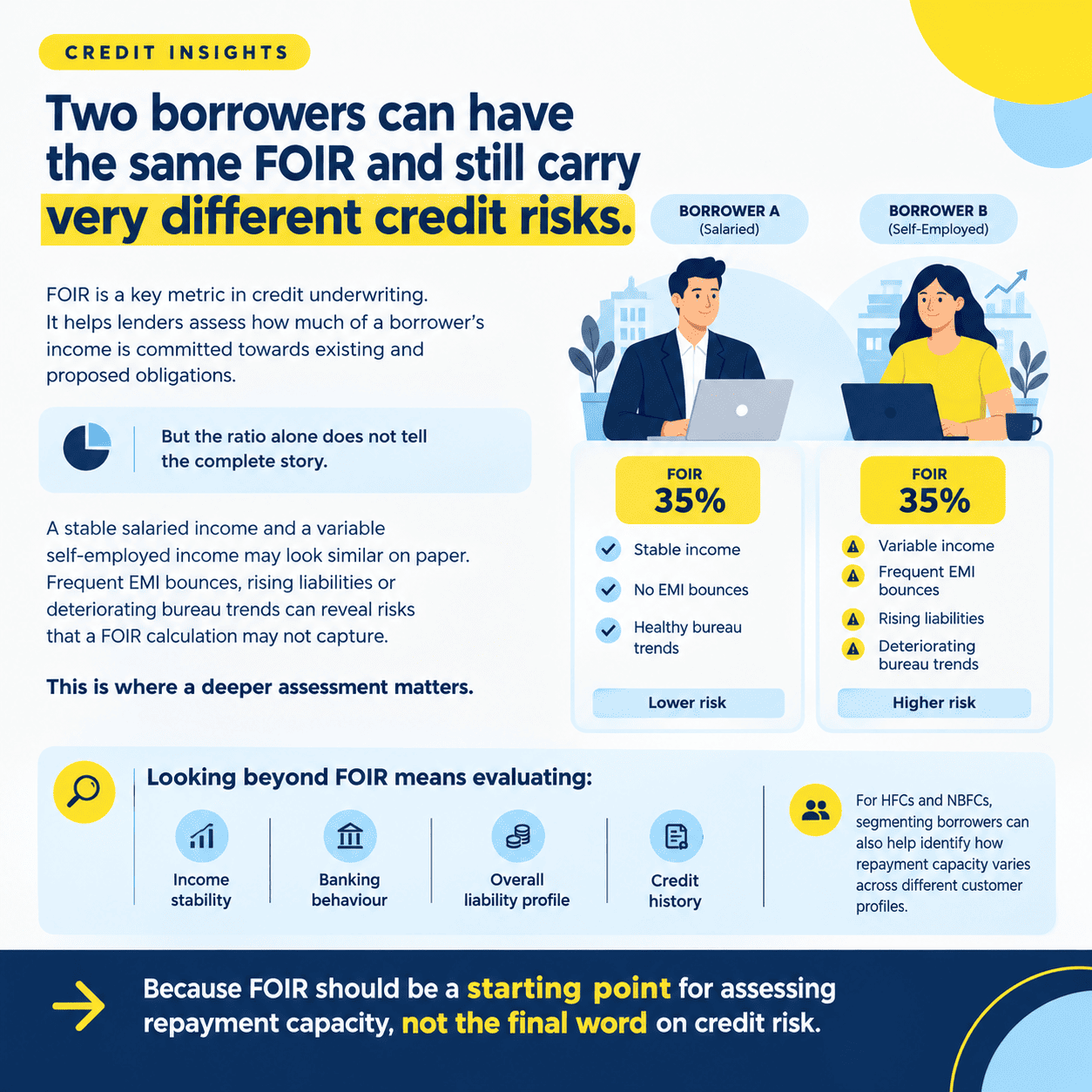
FOIR is one of the most commonly used indicators in credit underwriting. It helps lenders assess how much of a borrower’s income is already committed towards existing and proposed obligations.
But FOIR, by itself, does not tell the complete story.
Two borrowers can have the same FOIR and still present very different risk profiles. The difference often lies in factors such as income stability, banking behavior, bureau trends and the structure of the proposed loan.
A borrower’s income is not only about how much they earn, but also how consistently that income is generated.
A salaried borrower with stable employment may present a different risk profile from a self-employed borrower with the same income and FOIR. Similarly, borrowers with seasonal or variable cash flows may require a closer assessment of repayment capacity.
FOIR tells lenders how much income is committed. It does not tell them how resilient that income is.
A FOIR calculation is only as reliable as the obligations included in it.
Recent borrowing, changes in outstanding liabilities or additional financial commitments can alter a borrower’s actual repayment position. A borrower may appear comfortable based on the calculated ratio while their overall financial commitments are increasing.
Looking at the broader liability profile can therefore provide a more accurate picture than relying on the ratio alone.
Banking behavior can reveal how a borrower actually manages cash flows.
Irregular credits, frequent EMI or cheque bounces, declining balances and dependence on short-term inflows can provide useful signals when assessing repayment capacity.
The question is not simply whether a borrower can meet the EMI on paper. It is whether their actual cash-flow behavior supports that assessment.
A credit score is an important underwriting input, but it does not capture the entire credit profile.
Recent enquiries, repayment behavior, delinquency trends, credit utilization and the borrower’s credit history can provide additional insight into how their risk profile is evolving.
Looking at these trends alongside FOIR can help lenders move beyond a static view of borrower risk.
Borrower profiles are rarely identical.
Salaried borrowers, self-employed professionals and business owners can have very different income characteristics and cash-flow patterns, even when their FOIR is the same.
For HFCs and NBFCs, segmentation can help lenders understand repayment behavior across different customer profiles rather than relying on a single interpretation of FOIR.
Moving Beyond a Single Ratio
FOIR remains an important part of credit underwriting. The challenge arises when it becomes the conclusion rather than one input into the decision.
A stronger assessment brings together income stability, total obligations, banking behavior, bureau trends, borrower segment and loan structure.
The objective is not to move away from FOIR. It is to understand what sits behind it.
FOIR can tell a lender how much of a borrower’s income is committed. It cannot, by itself, tell the lender how stable that income is or how the borrower manages their overall financial obligations.
For lenders, the better question is not simply whether the FOIR is within the threshold, but what the FOIR may be leaving out.