
Businorem ipsum dolor sit amet cons interdum quam duis variuy time honored tradition etting .
Businorem ipsum dolor sit amet cons interdum quam duis variuy time honored tradition etting .
 August 25, 2026
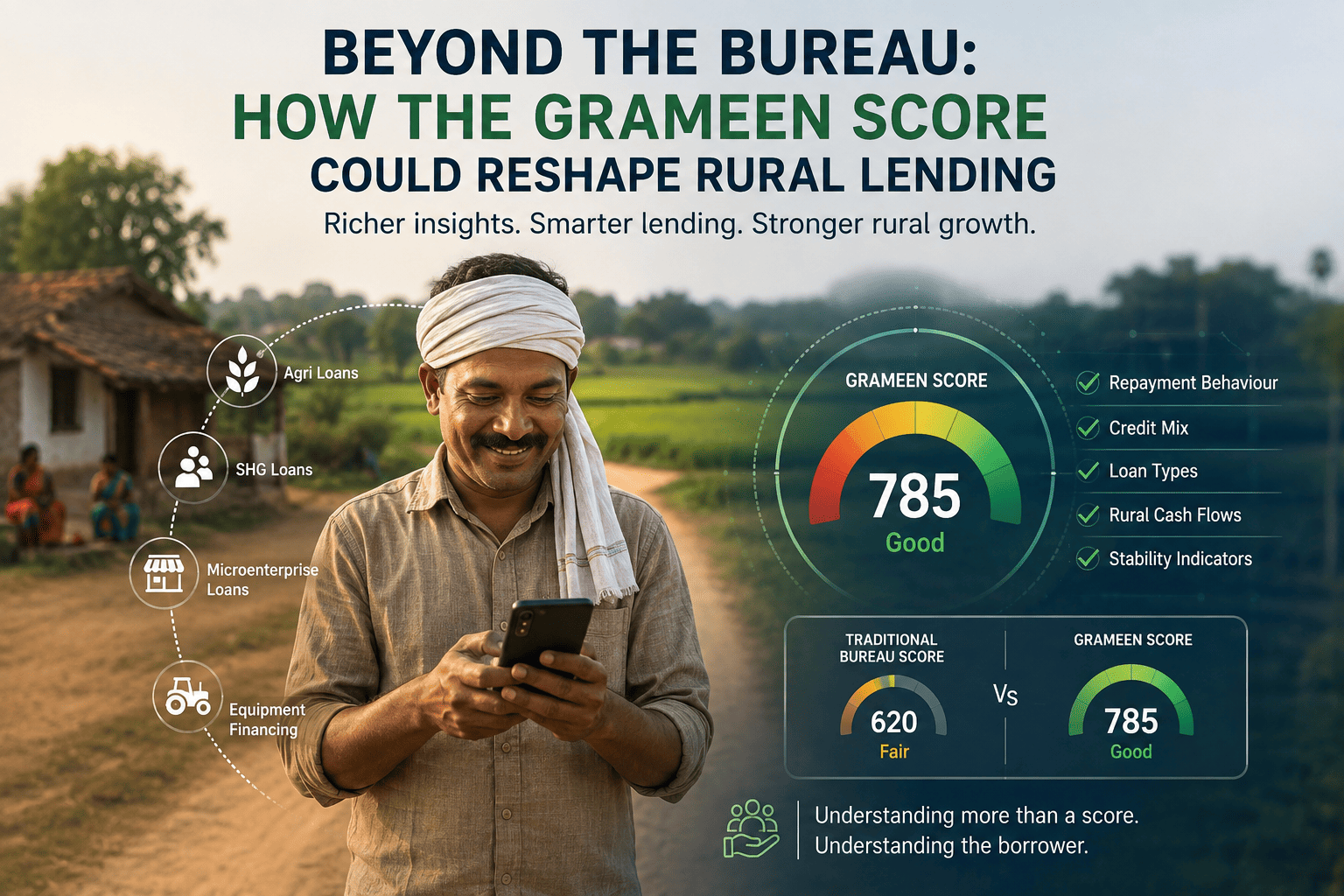
 For years, the credit bureau score has been one of the most important indicators in lending. A strong score signals responsible repayment behaviour, while a weak score often raises an immediate question around credit risk. But for millions of rural borrowers in India, the challenge may not be poor credit behaviour. It may simply be that traditional credit scores do not capture enough of it.
This is where alternative credit scoring, including the emerging Grameen Score, could reshape the way rural creditworthiness is assessed.
India’s rural borrowers often operate within financial ecosystems that look very different from those of salaried urban borrowers. Farmers, small traders, self-employed individuals, micro-entrepreneurs and members of self-help groups may have seasonal incomes, multiple sources of livelihood and limited exposure to formal credit. Their repayment capacity may therefore not always be adequately reflected through a conventional bureau score.
A borrower with a limited credit history could still have a consistent record of repaying microfinance loans, agricultural credit or other small-ticket borrowings. Yet, when viewed through a traditional scoring lens, the same borrower may appear as a thin-file or relatively higher-risk customer.
This creates an important distinction: limited credit visibility does not necessarily mean limited creditworthiness.
The Grameen Score is an attempt to bridge this gap by bringing a more rural-specific perspective to credit assessment. Instead of relying only on conventional indicators, rural-focused scoring can incorporate credit behaviour across products and borrower segments that are more relevant to the rural economy.
The implications for lenders could be significant.
Better visibility into rural borrower behaviour can allow financial institutions to move away from broad assumptions about risk and towards more granular customer segmentation. Borrowers with strong repayment patterns but limited traditional bureau histories could potentially be identified more accurately, while customers showing signs of financial stress could be differentiated from those who are simply new to formal credit.
This can support better underwriting, more informed credit limits and potentially more appropriate pricing.
The opportunity extends across the lending ecosystem. Banks, NBFCs, HFCs and microfinance institutions are increasingly looking beyond traditional urban credit markets for growth. As these institutions expand deeper into rural and semi-urban markets, the ability to assess customers who do not fit conventional credit profiles will become increasingly important.
There is also a broader financial inclusion opportunity.
India’s rural economy is not defined by a single source of income. A household may combine agriculture with dairy, livestock, retail trade, transportation or other small businesses. Credit requirements can similarly range from working capital and agricultural finance to housing, vehicle and enterprise loans.
A scoring framework that better reflects these interconnected financial activities could help lenders understand the borrower beyond a single credit number.
However, the rise of alternative scoring should not be interpreted as the replacement of traditional bureau scores.
Bureau data will continue to remain an important foundation for credit decisions, particularly for borrowers with established formal credit histories. The larger opportunity lies in combining traditional and alternative signals to create a more complete picture of creditworthiness.
In this model, the bureau score answers an important question: How has the borrower behaved within the formal credit system?
A rural-specific score can add another layer: What does that behaviour look like within the context of the rural credit ecosystem?
That additional context could become particularly valuable for thin-file and new-to-credit borrowers, where a conventional score alone may not provide sufficient information to make an informed lending decision.
The larger shift, therefore, is not from bureau scores to alternative scores, but from standardised credit assessment to contextual credit intelligence.
As formal lending expands deeper into rural India, lenders will need models that recognise the realities of how rural borrowers earn, borrow and repay. The institutions that can distinguish between genuine credit risk and simply limited credit visibility will be better positioned to expand responsibly.
For rural India, the next phase of financial inclusion may therefore depend on more than increasing access to formal credit. It may depend on building better ways to understand the borrowers seeking it.
The question is no longer whether the bureau score matters.
It is whether, for the next generation of rural lending, the bureau score alone tells the whole story.