
Businorem ipsum dolor sit amet cons interdum quam duis variuy time honored tradition etting .
Businorem ipsum dolor sit amet cons interdum quam duis variuy time honored tradition etting .
 October 6, 2026
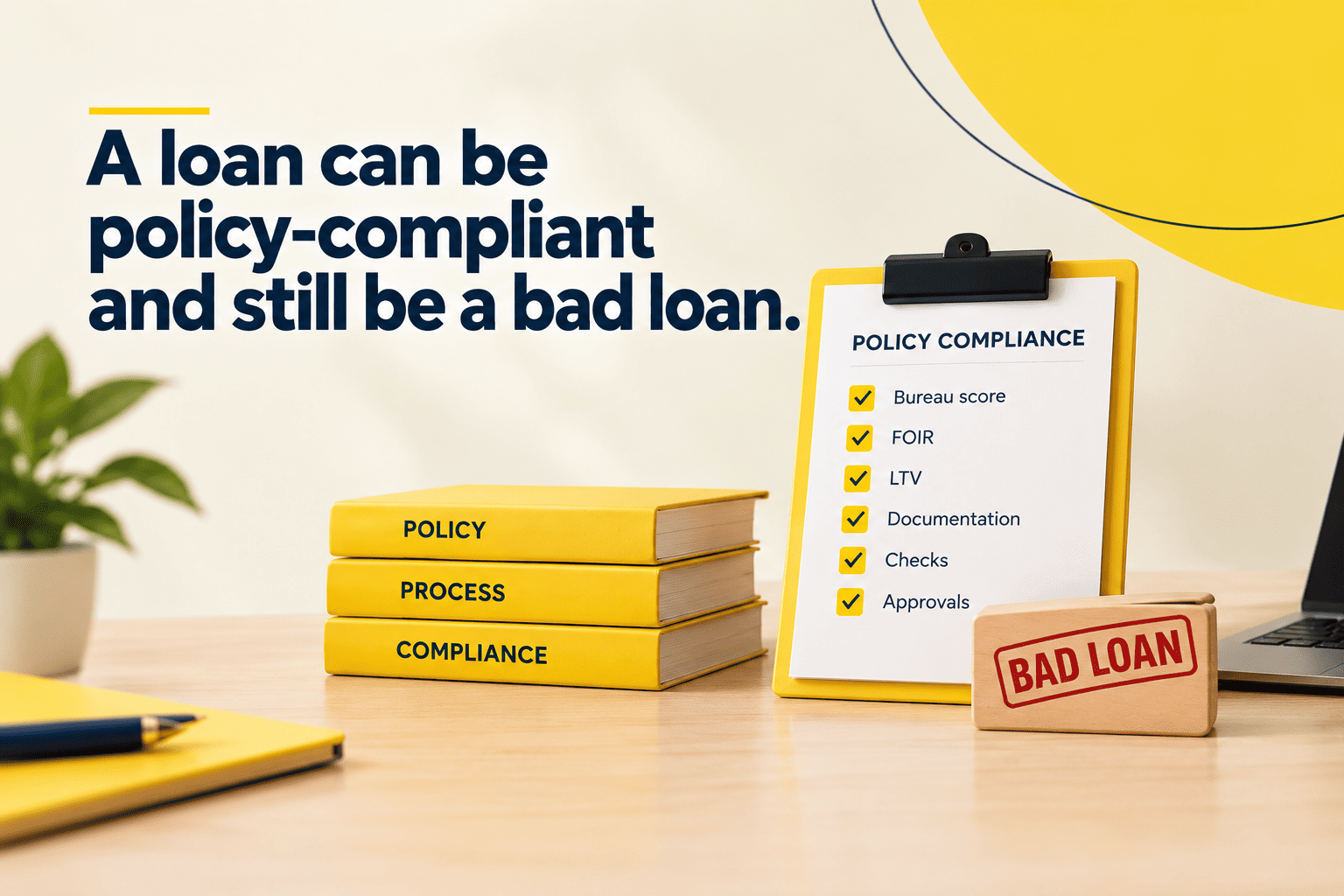
 In lending, adherence to credit policy is often viewed as a strong indicator of credit quality. When a borrower meets the prescribed credit score, FOIR and LTV thresholds, income has been verified, documentation is complete and the required approvals have been obtained, the loan is considered to be within the lender’s risk parameters. However, policy compliance and credit quality are not necessarily synonymous. A loan can satisfy every prescribed requirement and still turn out to be a poor lending decision.
The reason is that compliance and credit quality answer two different questions. Compliance asks whether the prescribed process and parameters have been followed; credit quality asks whether the lender has made the right assessment of the borrower’s ability and willingness to repay.
Credit policies necessarily rely on measurable indicators to assess risks that are often more complex. Bureau scores provide insight into historical credit behaviour but may not capture a recent deterioration in financial circumstances. FOIR provides a view of repayment capacity but may not fully reflect income volatility or sustainability. Similarly, an acceptable LTV provides a degree of collateral protection but does not necessarily address the quality, liquidity or enforceability of the underlying asset. These metrics remain important, but they are proxies for risk rather than risk itself.
The challenge becomes more pronounced as lending businesses evolve. Customer segments change, sourcing channels expand, new geographies are entered and products become more sophisticated, while credit policies often evolve more gradually. A parameter that was an effective risk discriminator when a policy was designed may therefore become less predictive over time. The issue is not necessarily that the policy is being violated; it may simply no longer be capturing the risks that matter most.
Policy exceptions provide another important signal. Exceptions are an inherent part of lending and, when appropriately governed, can address legitimate customer or business circumstances. However, recurring exceptions across particular products, geographies or customer segments should prompt a broader review. If the same deviations are repeatedly being approved, the question should not only be whether individual exceptions are justified, but whether the underlying policy remains aligned with the realities of the portfolio.
There is also a distinction between completing a control and effectively mitigating a risk. A verification check may have been performed and all required documents may be available, yet the underlying risk may remain inadequately understood. The more relevant question is whether the control materially improved the lender’s understanding of the borrower, transaction or collateral.
This calls for a shift from a predominantly compliance-led approach towards a more outcome-oriented approach to credit risk. Loans that deteriorate despite being policy-compliant should be systematically analysed to identify missed indicators, recurring exceptions, common characteristics or weaknesses in the assessment process. Insights from credit, portfolio analytics, collections, risk containment, fraud investigations and post-disbursement monitoring should then feed back into credit policy and underwriting practices.
Ultimately, the objective of a credit policy should not simply be to ensure that every loan passes a prescribed checklist. It should be to improve the quality of lending decisions and the probability of sustainable portfolio performance.
Policy compliance is a necessary condition for sound lending, but it is not sufficient. The real test of a credit policy is not how many loans comply with it, but how well those loans perform.